Blog
The Tension with Conveyor Belt Maintenance
Service Questions with Dakota: The Tension with Conveyor Belt Maintenance
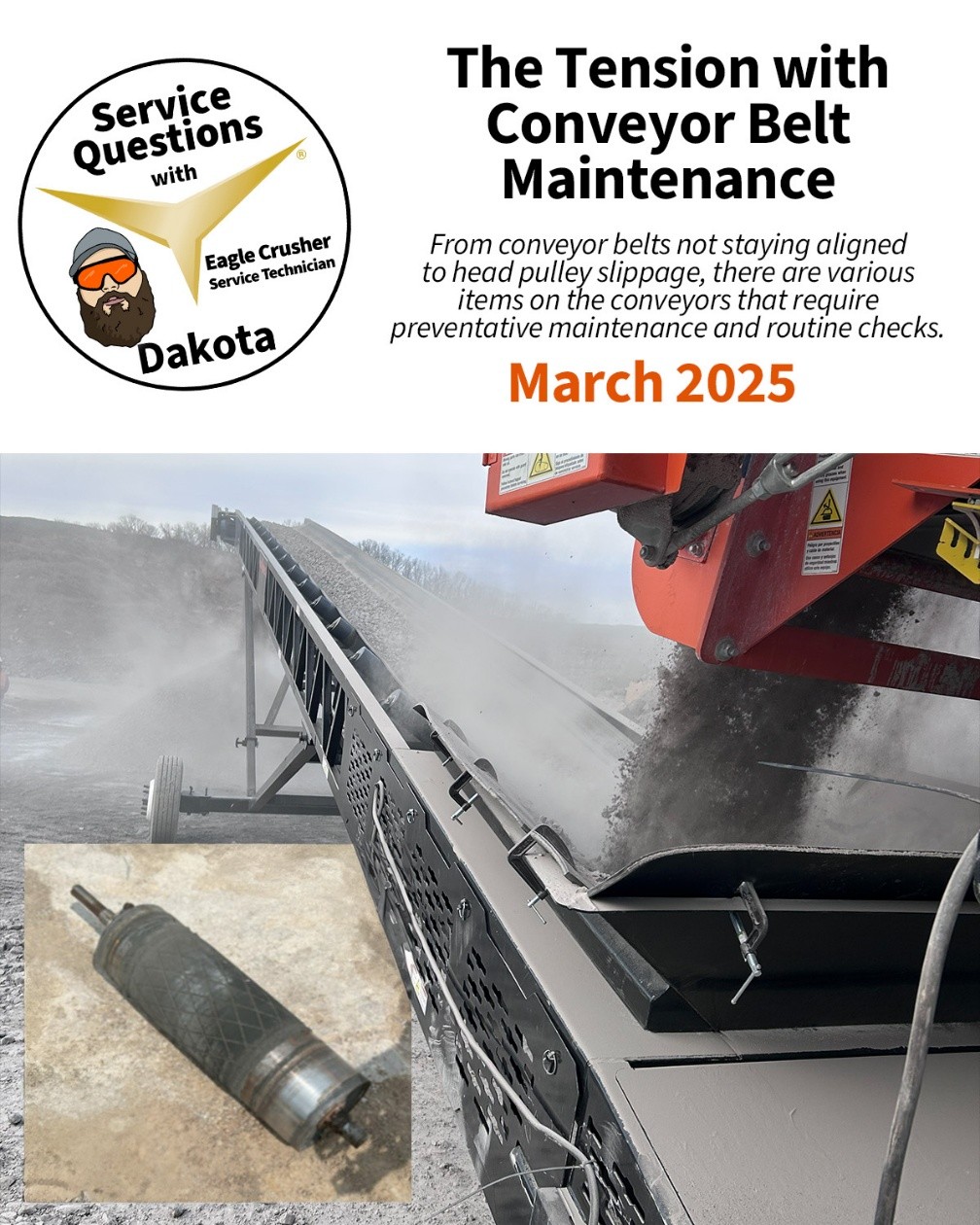
As we saw in Eagle Crusher Service Manager John’s recent Service Questions, a common area on rock crushing equipment that leads to constant questions is the conveyors. From conveyor belts not staying aligned to head pulley slippage, there are various items on the conveyors that require preventative maintenance and routine checks. Service Technician, Dakota, will run through the various questions that come from conveyor maintenance.
Conveyor Maintenance at a Glance
Common issues with conveyors involve the belt. For this Service Question, we will focus on the conveyor belt itself and not the motors or bearings involved in the pulleys. A common issue is the conveyor belt not staying centered. This can be caused by:
- Uneven Loading
- To fix this, you should adjust the loading to be more even by dumping from a chute to the center of the conveyor belt.
- Worn or Misaligned Components (Pulleys, Idlers)
- Check for worn or misaligned components by inspecting all pulleys and idlers to ensure they are free of any built-up material and ensure that the pulleys and idlers are properly aligned.
- Incorrect Tension or a Crooked Belt Splice
How often should conveyor belts be inspected or spliced?
Conveyor belts should be inspected daily to ensure the health and performance of the conveyor. You should be looking for various types of conveyor belt damage, such as cuts, frays, cracks, and wear. Make sure to clean off any debris buildup on the belt, pulleys, and rollers. Also, do a visual inspection to see if the conveyor belt is tracking straight and the splice is in good condition. Listen for unusual noises while in operation, such as grinding or squeaking, which could be misaligned or failing components.
How do I set proper belt tension?
Put marks on the nontensioned belt at exactly 1000 mm from the splice. The marking must be done on the left and right side of the conveyor belt. Tension the belt and let it turn a few times to equally divide the tension. Then, measure the elongation and adjust the belt tension if necessary. See your owner’s manual for the recommended elongation of the conveyor belts.
What is causing slippage at the head pulley?
To drive a conveyor belt without slippage, and to track it in a proper way, a certain tension of the conveyor belt is necessary. See your owner’s manual for the recommended tension.
Built up materials such as fines material will increase the friction between the conveyor belt and the head pulley, so it is very important to clean your conveyor properly. If slippage continues the belt could damage the lagging of the head pulley by rubbing it smooth, causing it to struggle to grip the conveyor belt.
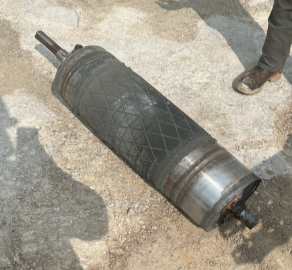
An example of a head pulley that is missing half the lagging.
How can I reduce material buildup under the conveyor belt?
You can reduce the buildup under a conveyor belt by ensuring the belt flashing or skirting is in good condition and making good contact with the conveyor belt. The skirting is adjustable by clamp plates. To adjust the skirting to avoid gaps in the flashing, simply loosen the clamp plates and pull the skirting down. If you can no longer pull the skirting down, you need to order new belt skirting.
After you have made sure your belt skirting is adjusted properly, inspect your belt scrapers and ensure they are making good. If the belt scrapers are not making good contact, adjust the scraper toward the belt by loosening the tensioner retainer screw and put tension on the scraper. You can do that by using a wrench to build tension, then tightening the retainer screw back down.
Don’t Let the Tension Get to You – Reach Out!
As you already know, a simple-looking part in rock crushing equipment doesn’t always mean it’s immune to preventative maintenance. What is simple is knowing the resources available to you. Not only do you have your owner’s manual, but you have a network of authorized dealers, a team of Eagle Crusher parts experts, and Eagle Crusher Service Technicians ready to help keep your tension to a minimum.