

Blog
What Is Primary, Secondary, and Tertiary Crushing?
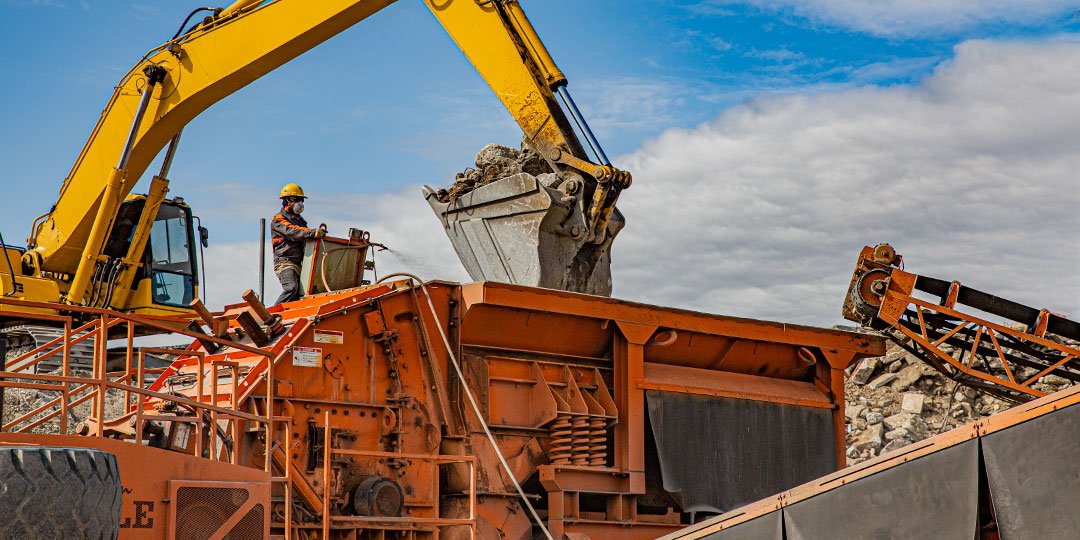
There are many ways to crush a rock—and depending on your industry, your location, and the project specifications, the equipment that you use and the layout by which it crushes that rock is often rather unique, especially when it comes to product size.
Rock crushing stages are essential to crushing and aggregate processing operations. The degree to which material is reduced through primary, secondary, and tertiary crushing can depend on the type of material, like aggregate, concrete, and asphalt, and can also depend on the variety of output sizes needed.
Here, we break down each crushing stage, explain the equipment used at each level, and help you understand when single-stage versus multi-stage crushing makes sense for your operation.
Primary Crushing: The First Stage of Material Reduction
Primary crushing is the first stage of material reduction and can sometimes be the only stage needed to generate the desired product for a job. Depending on the setup, primary crushing will take the larger material that has been blasted, excavated, or reclaimed and process it through an impactor, jaw, or gyratory crusher to generate a range of product sizes.
Key characteristics of primary crushing:
- Processes the largest material (typically 800mm to 1500mm)
- Reduces material to approximately 150mm to 300mm
- Common equipment: jaw crushers, gyratory crushers, and impact crushers
- Often used in closed-circuit portable crusher plants with scalping and screening capabilities
For many aggregate producers, utilizing a closed-circuit portable crusher plant with scalping and screening capabilities can be all they need to create the product they need. But when a wider variety of product is desired and certain material is being processed, like concrete and asphalt, it can be valuable to rely on additional rock crushing stages, like secondary and tertiary.
Secondary Crushing: Refining Material Size
Secondary crushing is the second stage of material processing following its initial reduction. At this stage, material will flow through perhaps a second impactor or even a cone crusher, which is effective at breaking down these types of material.
Secondary crushing typically:
- Accepts material from 150mm to 300mm
- Reduces output to 50mm to 100mm
- Uses cone crushers or horizontal-shaft impactors
- Produces more uniform, cubical products
Tertiary and Quaternary Crushing: Achieving Finer Reduction
There are also tertiary and even quaternary stages of crushing to achieve finer levels of material reduction. These stages, in addition to secondary crushing, can often be laid out utilizing an open-circuit portable crusher plant system where processed material is screened and conveyed from one crusher to the next.
Advanced crushing stages deliver:
- Final product sizes as small as 10mm or less
- Higher quality, more consistent material
- Multiple product grades from a single operation
- Increased versatility for specialized applications
The Value of Multi-Stage Crushing and Aggregate Processing
Relying on these many rock-crushing stages beyond the primary stage can add significant value to a crushing operation. Not only can multiple product sizes be generated, but in an open-circuit crushing layout, the material flow and processing are streamlined, often increasing output compared to a closed-circuit layout.
Open-Circuit vs. Closed-Circuit Crushing Layouts
Understanding the difference between these two configurations is crucial for crushing and aggregate processing efficiency:
| Closed-Circuit Systems | Open-Circuit Systems |
|---|---|
| Material is screened and oversized particles return to the crusher | Material passes through once without recirculation |
| Ensures consistent product sizing | Allows for sequential crushing stages |
| Ideal for single-stage operations | Increases overall throughput |
| Better for tight specifications | Optimal for multi-stage operations producing various product sizes |
Eagle Crusher: Your Partner Through All Rock Crushing Stages
Eagle Crusher offers a comprehensive portfolio of closed-circuit and open-circuit portable crusher plants, manufacturing powerful equipment like horizontal-shaft impactors, jaw crushers, and cone crushers that are critical for any stage of crushing and aggregate processing. With American-made equipment built for durability and backed by 24-hour parts and service, we can help you determine which crushing equipment and configuration will be best for your next project. Serious projects demand Eagle Crusher–contact us today.