

Blog
Sheaves and Belts Preventative Maintenance
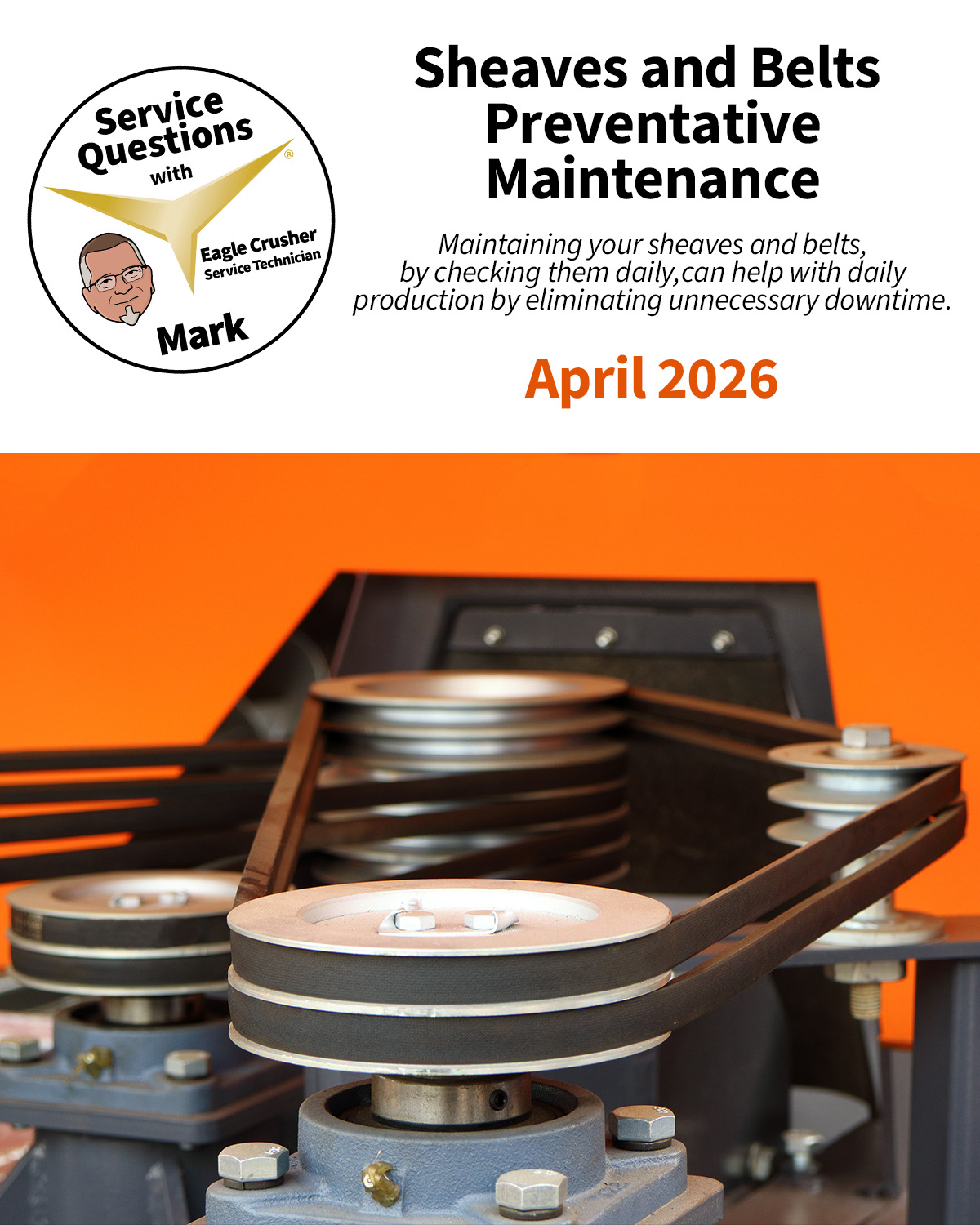
Service Questions with Mark: Sheaves and Belts
This “Service Questions” is about a specific part of your crusher system and while it may seem like a small part, it can have large issues if it’s not taken care of properly. A sheave is a grooved pulley or wheel that is used to guide conveyor belts that handle heavy loads such as aggregate, concrete, and asphalt. Maintaining your sheaves and belts, by checking them daily, can help with daily production by eliminating unnecessary downtime. Eagle Crusher Service Technician, Mark, will go over some tips and tricks to maintaining your sheaves and belts.
Sheave Preventative Maintenance Routine
If a belt can’t grip the sheave properly, you will have a loss of RPMs that are required to do a specific function. In the case of a generator bult, it may not produce your full voltage that is required to operate your crusher. It’s important that you check your sheaves using the appropriate tools.

You’ll want to check that your sheaves are flush with the appropriate gauge. If the gauge is not flush with the sheave’s ridges, it is worn down and will cause belt slippage.
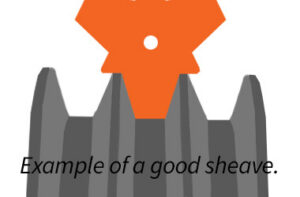
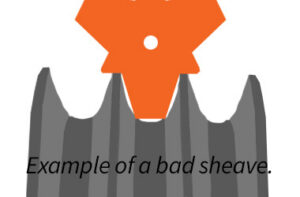
Of note, the crushing of asphalt can create significant amounts of dust which can lead to premature wear on your sheaves.
If you’re looking for sheave gauges, new sheaves, or new belts, reach out to Eagle Crusher’s parts team or your authorized local dealer.
Belt slippage from worn sheaves or improper tension can result in sheaves not rotating at the expected speed. Depending on the diameters of the sheaves they may rotate at different RPMs in the system. The way to check this is by applying reflective tape on all your sheaves and watching them run. Check your sheave RPMs with a Photo Tach. For example, if the engine is running 1800 RPMs your sheave on the motor should also be spinning 1800 RPMs and the driven sheave will spin at an RPM determined by the diameter ratio. While the crusher is running, assure that all sheaves are spinning without unexpected differences in speeds.
If the sheaves are not spinning at the expected speed as the engine, you need to check the belt tension. See owner’s manual for tensioning process.
Belts Preventative Maintenance Routine
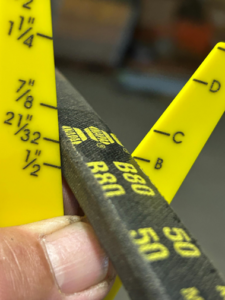
Belts and sheaves can also be worn and not have proper contact surfaces for power transmission. The drive belts and sheave gauges that can determine the amount of wear.
The belts and sheaves are labeled with the size designation. When you put in a belt gauge you can determine if the belt and sheave is worn beyond its wear limit. For an example using the image below, note that the belt shown is marked with a “B” so the belt should land on gauge line B. If your belt does not match up with the gauge, then you’ll need to replace the belt.
Getting the Right Parts
If you need to replace any parts that are worn, such as sheaves and belts, you can reach out to Eagle Crusher’s Parts Team or any authorized dealer for assistance. Always refer to your owner’s manual for information that’s specific to your machine and practice maintenance safety by using the lock out / tag out method. Eagle Crusher is with you every step of the way, from start up to preventative maintenance and beyond.